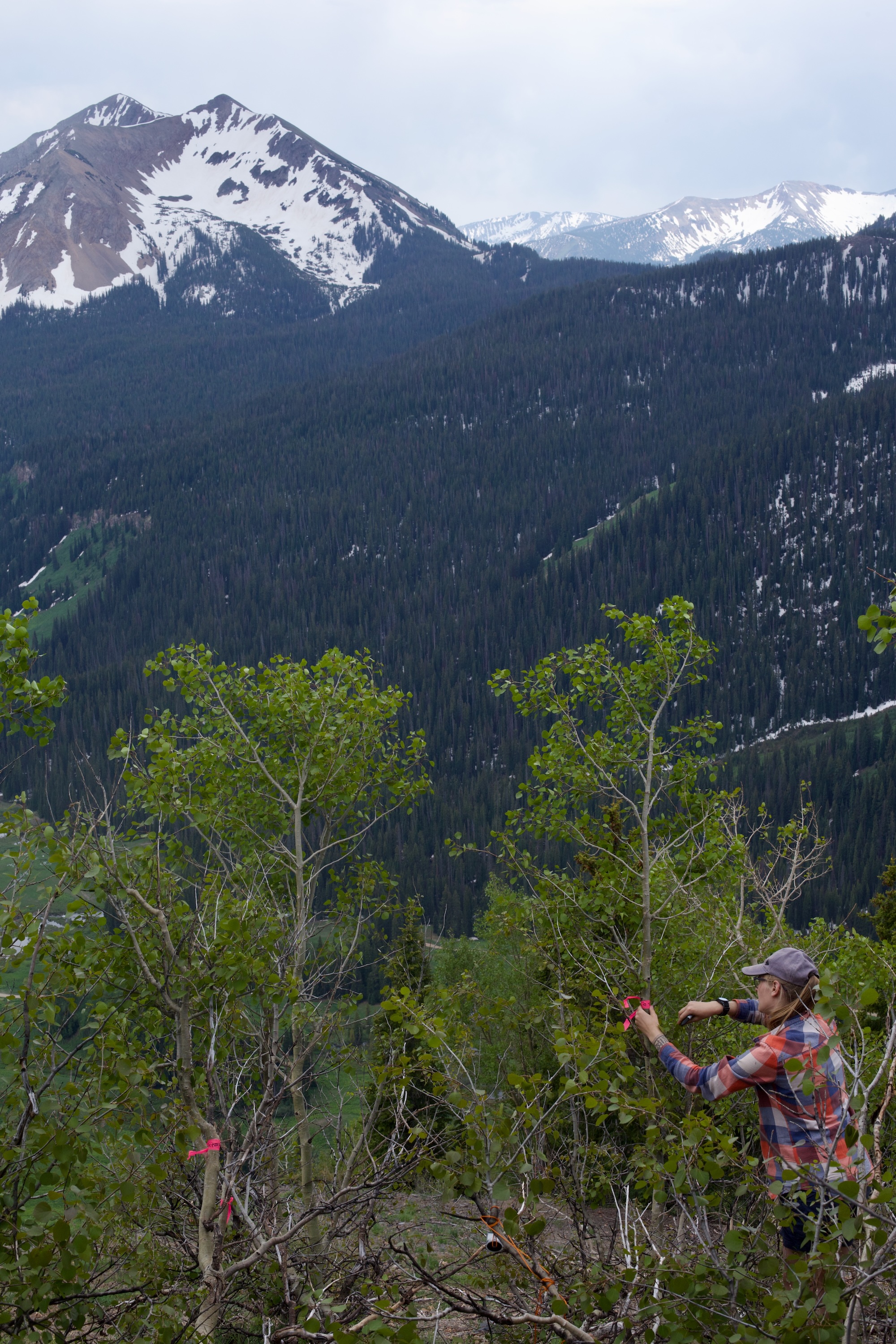

(guest post by lead author Dr. Jolanta Rieksta, who did this project as her masters’ thesis)
A fundamental question in trait-based ecology is whether variation within species across environmental gradients is primarily driven by genetic differences, resulting in local adaptation with little or no variation among genotypes, or by phenotypic plasticity, where individuals can adjust their traits in response to changing conditions. Studying trait variation within genetically identical individuals (clones) in natural populations, allows us to estimate the lower bound for the importance of plasticity in shaping trait covariation within species, such as those described in the leaf economics spectrum (LES). The LES is widely used to understand plant trait variation, adaptation to different environments, and ecosystem responses to climate change.

In this study, we investigated genotype, cytotype, microclimate, and herbivory as potential drivers of leaf functional trait variation in 15 quaking aspen genotypes that varied in cytotype (diploid or triploid) and long elevation gradient in Southwestern Colorado.
We show that the classic trait relationships of the LES are substantially relaxed within quaking aspen. Rather than occupying fixed positions in trait space, aspen genotypes exhibited diverse and context-dependent trait values, where variation in genotype, cytotype, and herbivory pressure each contributed to this pattern. This means, that the overall species pattern is the outcome of a complex interplay between genetic variation and plastic responses to biotic and abiotic environment. Such relaxation of the LES within species may enable more flexible responses to environmental stressors through both genetic and plastic mechanisms.
Read the full open access article here:
OIKOS: Relaxation of the leaf economics spectrum within and across quaking aspen (Populus tremuloides) genotypes https://nsojournals.onlinelibrary.wiley.com/doi/10.1002/oik.11279

Figure 1 Large within species variation in aspen trait relationships for 15 individual genotypes (A-B) and aspen cytotypes (diploids and triploids) show variation in resource-use tradeoffs. (A) The relationships between leaf nitrogen (LNC) and specific leaf area (SLA); (B) the relationships between LNC and photosynthetic capacity (Amax).Each solid coloured line defines one aspen genotype; the dashed line indicates the overall aspen slope from this study. (C) The relationship between leaf lifespan (LL) and specific leaf area (SLA); (D) the relationship between LNC and photosynthetic capacity (Amax). Each solid coloured line defines cytotype; the dashed line indicates the overall aspen slope from this study.