-
Melt out
Early spring is when the elevation contrasts of Britain’s mountains are clearest. These weeks I have been wandering through England and in Wales, climbing where possible, seeing what could be found among the valleys and hilltops. The transition between winter and spring means that the valleys are warm, and the hilltops are still cold, so…
-
New paper: learning to see what is missing
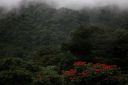
The red flowers of the invasive African tulip tree (Spathodea campanulata; Bignoniaceae) stand out in a Puerto Rican rain forest. This species may occupy a mathematical hole, having an ecological strategy unoccupied by other species in the community. Recent mathematical advances now allow detection of holes and better understandings of species invasions and extinctions. Imagine…
-
Simple winter scenes
Winter in the United Kingdom is quiet. Organisms retreat underground or migrate to less harsh climates. Only simple winter scenes remain, painted in broad figures with a restricted palette of colors. The complexity of summer is temporarily washed away. Fields are seas of black soil, prepared for spring planting. Coastal landscapes are brown, dominated by…
-

New paper published: a tour of the Hawaiian silverswords
I think every biologist has a favorite kind of organism. For some people it is a charismatic animal, like an elephant, or a whale. For me it is silverswords. I first learned about these plants in my first year of graduate school. Someone was giving a lecture on adaptive radiations, and showed photographs of a…
Search
Mail: 32 Giannini Hall, Berkeley, CA, 94720 USA
Visit: 305/309 Hilgard Hall