(guest post by lead author Dr. Jocelyn Navarro)
We just put out a new paper focusing on an overlooked but critical trait: minimum leaf conductance (gmin). Minimum leaf conductance is the water loss through the cuticle or “leaky” stomata after stomatal closure. This trait is increasingly being recognized as a key component of plant hydraulic behavior, but the sources of variation are poorly understood. In this study, we measured gmin in triploid and diploid aspen, along with other traits associated with plant water-use and structure. We also accounted for microsite effects. Our results show triploids consistently had higher gmin than diploids across models, accounting for structural traits and topography. These findings add to the growing understanding of the predictors of gmin and in aspen, higher gmin in triploids may be a critical mechanism underlying differences in mortality risk by ploidy level.

Here we show Model‐predicted gmin between (A) surface‐area‐to‐volume ratio (SA/V; m–1) by ploidy level, (B) leaf area (LA; m2) by ploidy level, (C) cosine aspect by ploidy level, and (D) slope by ploidy level of aspen. Each plot includes a regression line and a 95% confidence interval by ploidy level. Ploidy level remained a significant predictor of gmin.
This paper was first-authored by Roxy Cruz-de Hoyos, a postdoctoral researcher in the lab and Jocelyn Navarro, a recent Ph.D. graduate from the University of Arizona’s Department of Ecology and Evolutionary Biology. The paper was selected by the editor-in-chief to be featured in the “Highlights” section of the July issue of AJB.

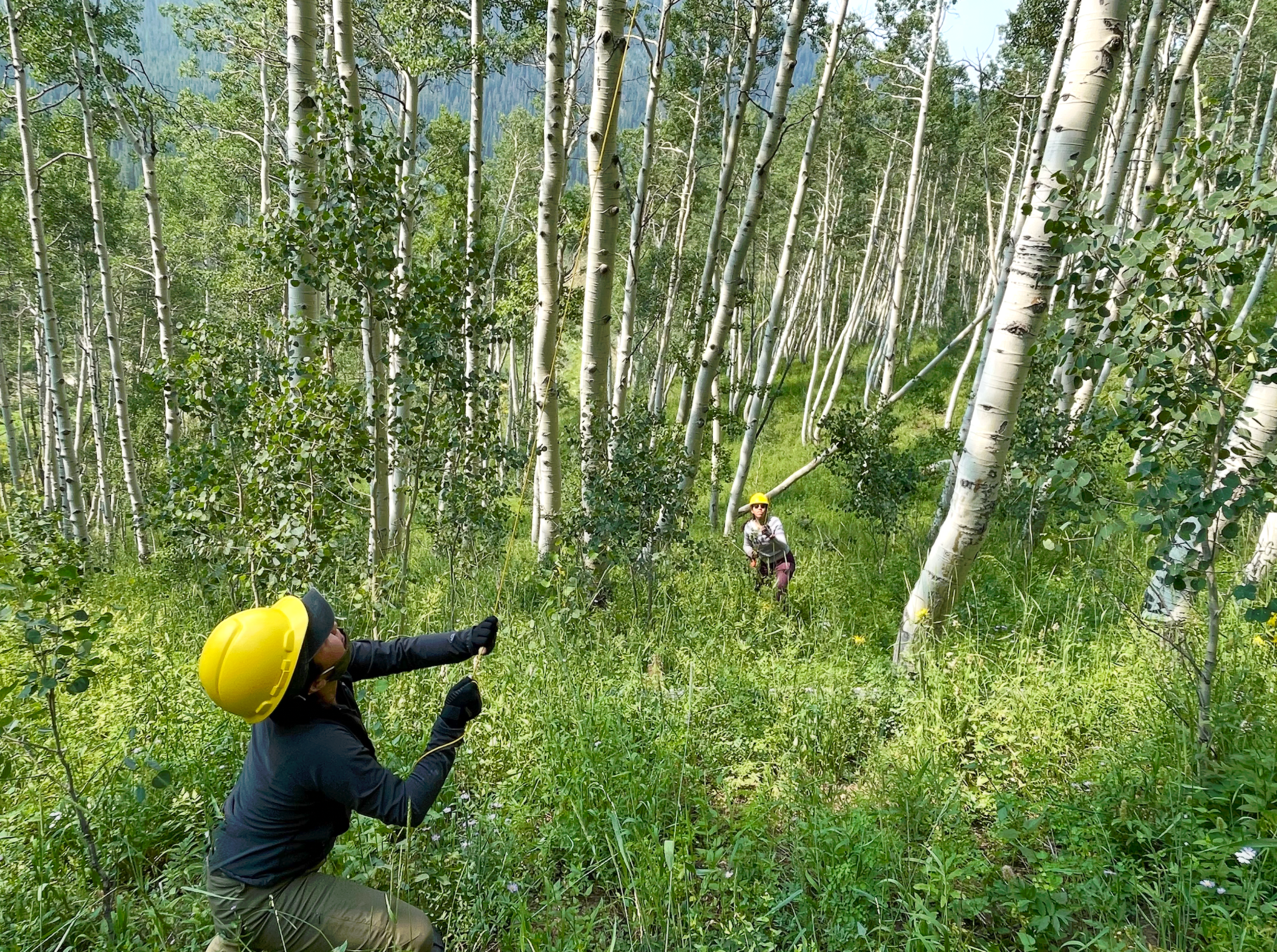
Drs. Roxanne Cruz de-Hoyos (left) and Jocelyn Navarro (right) using a rope system to collect a quaking aspen branch to measure minimum leaf conductance.